Anthony Micheal Idedia

Monitoring, evaluation and research for development programmes in Nigeria

I turn programme data into evidence that teams, donors and government act on.

In 2026 that has meant leading the field team for the Nigeria arm of a UNICEF and WFP study on child malnutrition, co-creating WimBiz's organisation-wide monitoring and evaluation framework, and training the field team for WFP's independent monitoring in Northeast and Northwest Nigeria.

I build systems that take routine work off people's hands, including one that turns interview recordings into checked transcripts and translations in any language. What follows is the work itself, with the images to show it.

Work delivered for

  • UNICEF
  • World Food Programme
  • WimBiz
  • Impact Investors Foundation
  • World Bank
  • WHO
  • PEPFAR
  • European Union
  • NMEP
  • Malaria Consortium
  • Danish Refugee Council

What I bring to your programme

  • Monitoring frameworks with the data flow designed in

    A framework only works if its data can move from collection to reporting and use. I co-created WimBiz's organisation-wide framework with a team of researchers, and I own its analysis and its data pipeline.

    See the WimBiz framework
  • Analysis that holds up, written for the people who act on it

    Every figure is traced to its source and graded for confidence. I led the analysis of a national malaria survey and co-authored the report whose pricing recommendations the National Malaria Elimination Programme took up.

    See the research
  • Field teams that collect data you can trust

    I recruit, train and test enumerators, then go back over the weak spots. On the UNICEF and WFP study, trainee scores rose from 14.0 to 16.2 out of 20, and my field team scored highest of the three teams on the joint pre-test.

    See the Katsina fieldwork
  • Routine work that runs itself

    Data requests and reminders for 158 organisations, field team contracts and payment lists, and a weekly scan of tender sources all run on their own, and I write the guides that let colleagues run them without me.

    See the systems
  • Interview findings while the team is still in the field

    A system I designed returns a timed Hausa transcript within minutes of an upload, translates it once a supervisor has checked it, and sends a daily summary of what the interviews are saying.

    See the transcription system

Designed for the UNICEF and WFP study in Katsina, 2026

Hausa interview recordings, turned into checked English transcripts

The joint operation plans 131 interviews and group discussions across Dutsin-Ma, Safana and Kafur. Done by hand, every recording means hours of typing and translating, and the picture across interviews only comes together once the team has left the field.

I designed a system that does the routine part automatically and keeps a person on the step that needs judgement: checking the Hausa before anything is translated.

  1. 1Field supervisorUpload

    Uploads the recording to their area's folder in Google Drive.

  2. 2The systemTranscribe

    Gemini transcribes the Hausa in five-minute sections, in parallel, with a time on every line.

  3. 3Field supervisorCheck

    Corrects the draft against the recording, fills in the interview details and marks it ready. Nothing is translated before this.

  4. 4The systemTranslate

    Produces the English translation with a summary, key findings, themes and key statements.

  5. 5The systemShare

    Sends the documents to the supervisor and lets the study team know the translation is ready.

  6. 6The systemDigest

    Every evening, a numbered summary of coverage, themes and quotes by area, building on the one before. A separate copy for the field managers adds coaching points for the team.

Around the edges

  • Gives every interview an ID by area and logs each recording and who checked it.
  • Reminds supervisors about drafts they have not yet checked.
  • Takes typed notes from interviews that could not be recorded, and summarises and translates them too.
  • Labels speakers by role rather than name, and shares transcripts view-only.

What it changed

  • Minutes per interview instead of hours of typing and translating.
  • A person checks every Hausa transcript before it is translated, and every line carries its time in the recording, so any quote can be traced back to the audio.
  • Emerging issues reach the study team, UNICEF and WFP during fieldwork, not weeks after it.
  • Recordings stay in the project's own Google Drive.
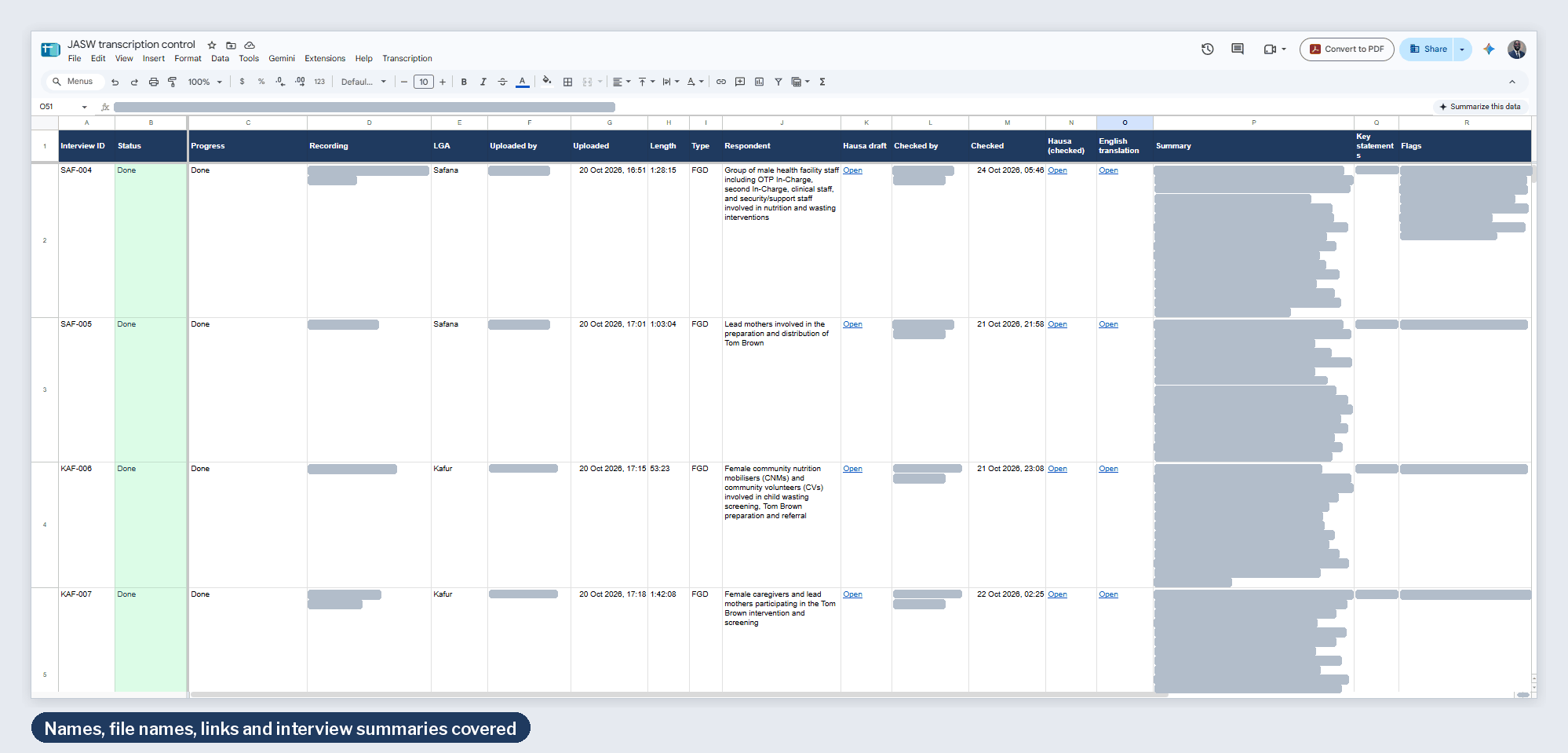
The transcription control sheet listing interviews by ID, with names, file names, links and summaries covered
The control sheet. Every recording gets an ID by area, and the log tracks its status, length and respondent group, who checked it, and a link to each document.
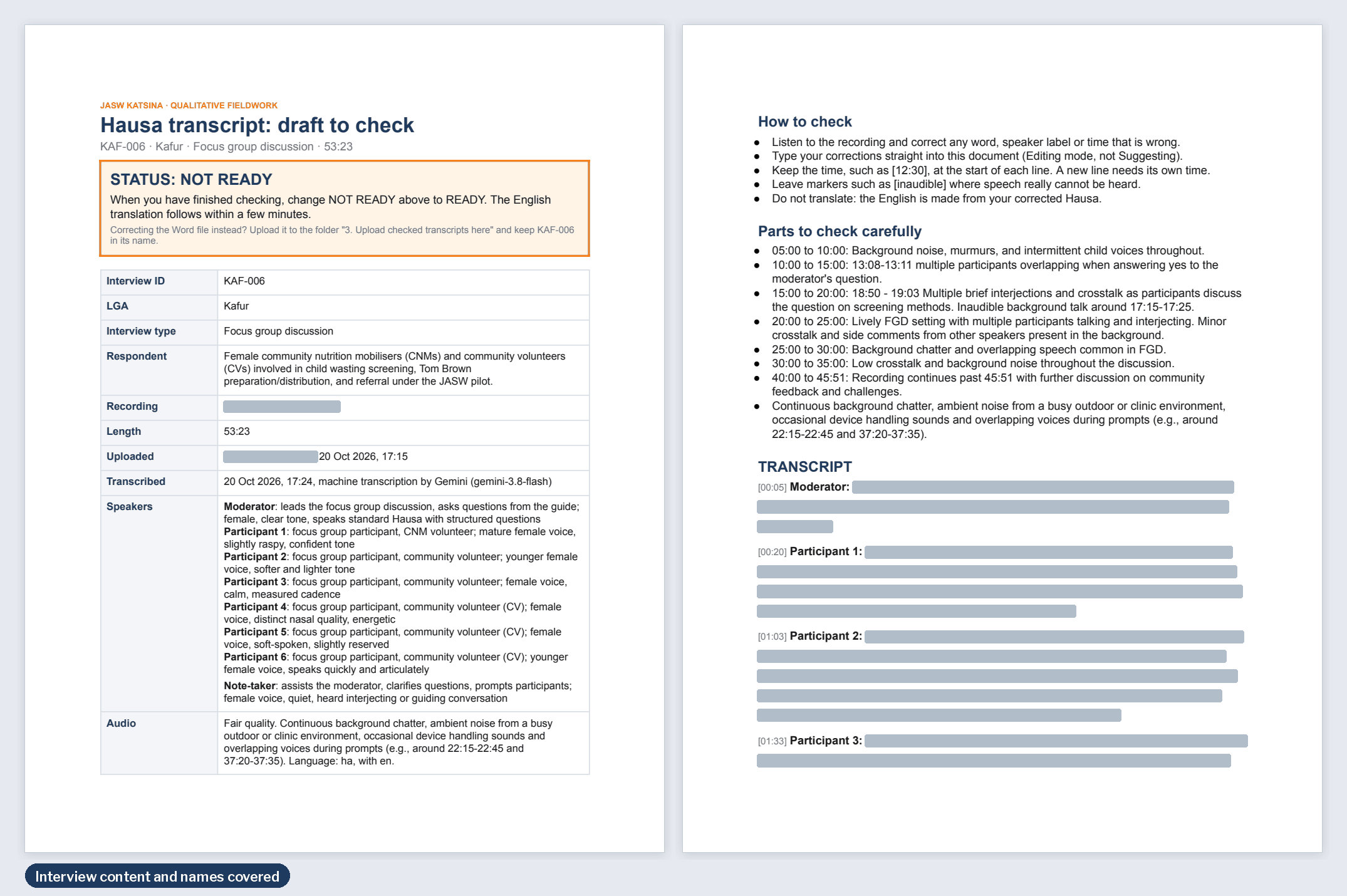
The first two pages of a Hausa draft transcript, with the transcript text and names covered
A Hausa draft as the supervisor receives it: the interview details, the passages to listen to closely, then the transcript, timed line by line and labelled by role. Changing NOT READY to READY sends it for translation.
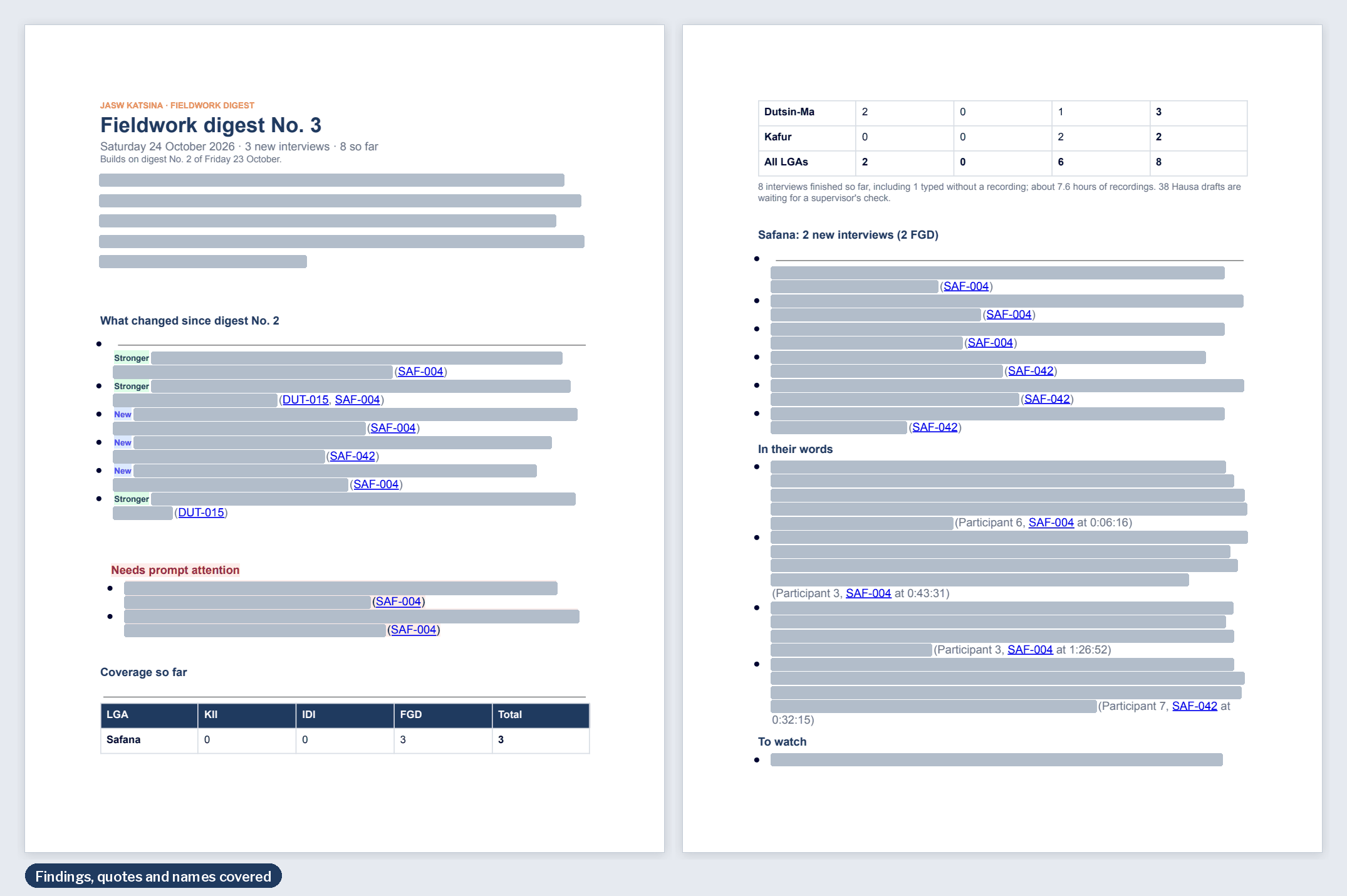
The first two pages of fieldwork digest number 3, with findings, quotes and names covered
Fieldwork digest No. 3, 24 October 2026. Each finding is marked new or stronger than in digest No. 2 and cites the interviews behind it, with coverage by area alongside.
Google Apps ScriptGeminiGoogle DriveGoogle SheetsGmail

Current work

UNICEF and WFPJoint Action to Stop Wasting
Field lead and trainer
2026Reporting due December 2026
Katsina State

How UNICEF and WFP's joint approach to child malnutrition works in practice

The Nigeria arm of a five-country study asking what has been changed on the ground and what could work better. I recruited and trained the field team, and I now oversee its data collection.
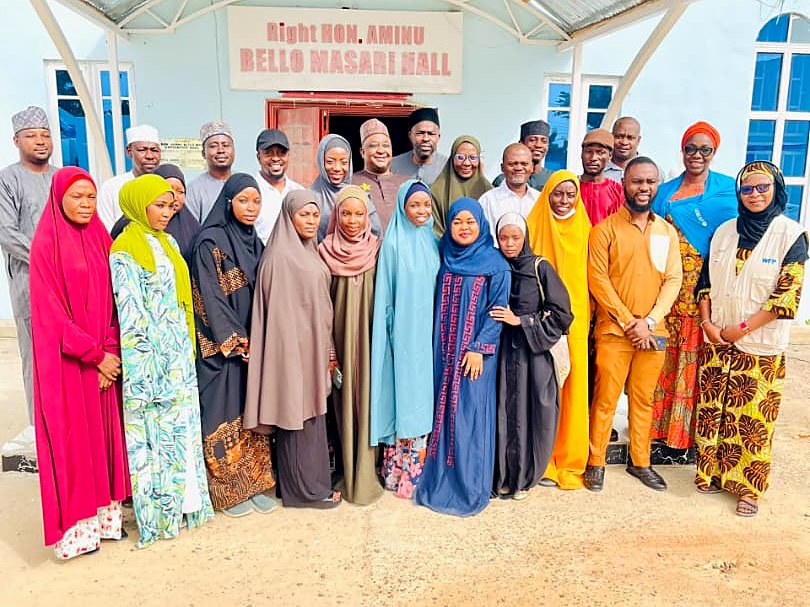
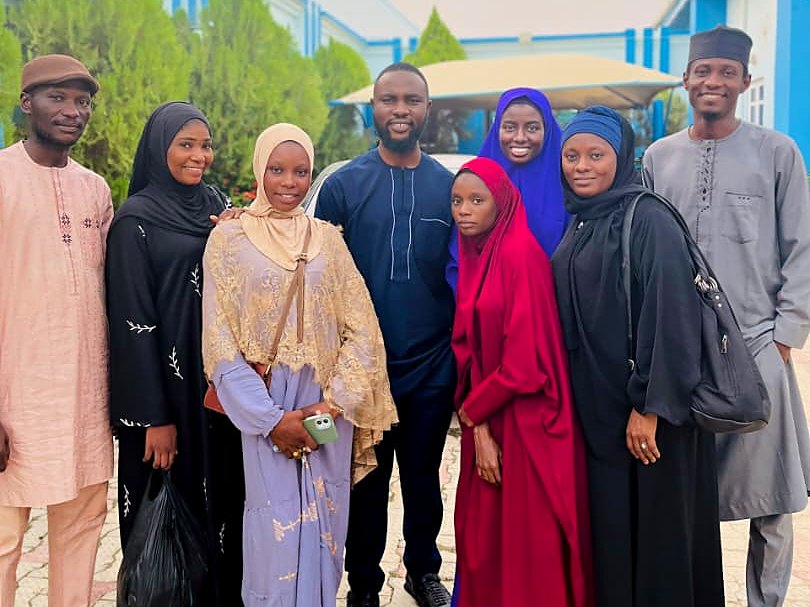
Anthony Micheal Idedia with UNICEF and WFP colleagues and the field teams in Katsina
With UNICEF and WFP colleagues in Katsina.
Anthony Micheal Idedia with the field team he trained
With the field team after training.
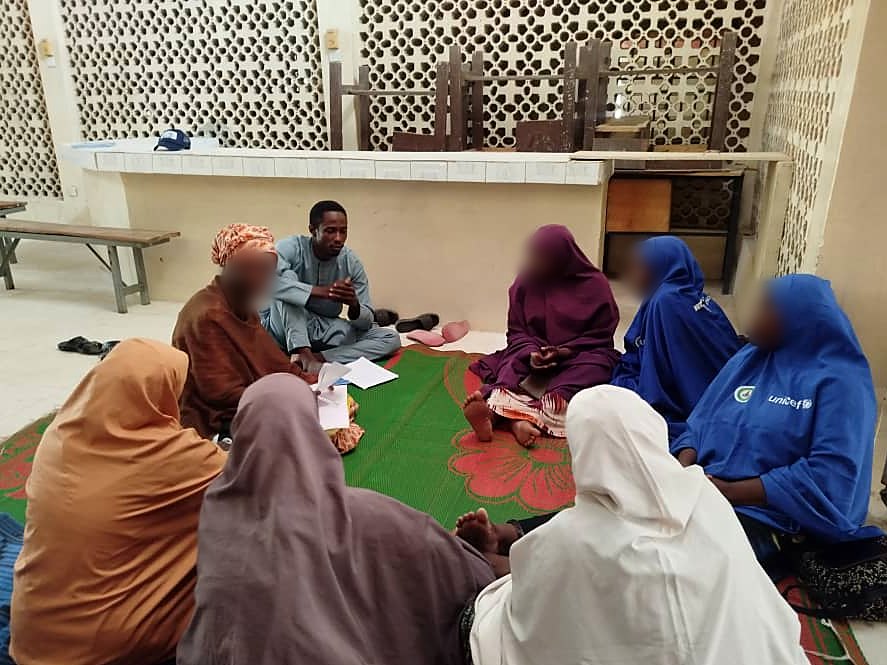
A member of the field team leading a group discussion, with the participants' faces blurred
A group discussion during fieldwork. Participants' faces are blurred.
14.0 to 16.2Average trainee score out of 20, before and after training
7 of 9Trainees whose scores improved
80 to 100%Scores on the consent and child protection questions
12.1 of 15My field team's score on the joint pre-test, highest of three teams
  • Trained six enumerators and a supervisor to run key informant interviews and focus group discussions, with a step-by-step guide to interviewing and a field brief I prepared.
  • Tested the team before and after training, then went back over weak spots such as probing with refresher lessons and quizzes on WhatsApp.
  • Ran the pilot on 8 October 2026 to test the tools, team pairings, recording and timing, then led the team on site into fieldwork, taking part in key informant interviews.
  • Built the transcription system above and an automated contracting system for the team, prepared the field budget and write the progress updates.
Key informant interviewsFocus group discussionsEnumerator trainingConsent and child protection

WimBizWomen in Management, Business and Public Service
Research and data analyst consultant
2026Framework submitted September 2026
Organisation-wide

A monitoring and evaluation framework to measure outcomes and long-term impact

Anthony Micheal Idedia with WimBiz stakeholders
With WimBiz stakeholders, October 2026.

WimBiz has worked since 2001 to advance women's leadership in the public and private sectors, through leadership development, mentoring, advocacy and research. The framework is designed to show how those programmes together lead to measurable results, rather than only counting activities.

  • I co-created the framework with a team of researchers and help monitor it. I own the analysis and the data pipeline behind its data strategy.
  • The framework brings together a theory of change, a results framework with SMART indicators and disaggregation, a monitoring plan, data flows and feedback loops, and the tools, templates and dashboards staff will use.
Theory of changeResults frameworkSMART indicatorsData pipelineDisaggregation
World Food Programme
Field team recruitment and training
2026In the field from October 2026
Northeast and Northwest

Independent monitoring of WFP operations in Northeast and Northwest Nigeria

Independent checks that WFP-funded operations are delivering what they should. I recruited the field team and trained them before deployment, and I take part in the monitoring directly.

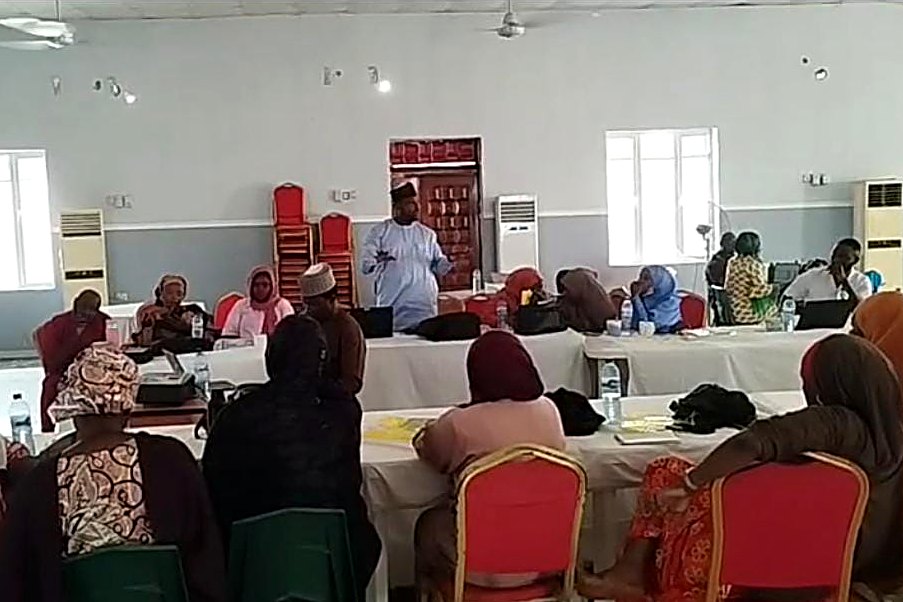
The WFP monitoring field team in a training session
Training the monitoring team before deployment.
Third-party monitoringEnumerator recruitmentEnumerator training
Impact Investors Foundation
Research and data consultant
2025 to 2026
158 organisations

Sizing Nigeria's impact investment market

The first full picture of impact-focused investment into Nigeria from 2020 to 2026, drawn from about 62 investors and 332 source documents, to a standard that stands up to public and investor scrutiny.

  • Set the rules for what counts, so money committed, money paid out and money under management are never confused with one another.
  • Found and fixed serious faults in the dataset I inherited: deals counted twice, different kinds of capital mixed together, dates that did not line up, and a currency conversion method that would have badly distorted the figures for Nigerian institutions.
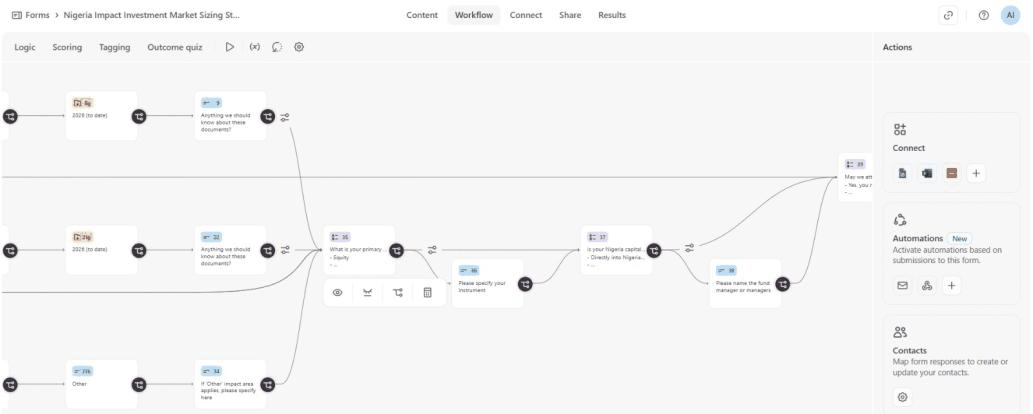
  • Built the system that collects data directly from 158 organisations, through a 42-question form that only asks each respondent what applies to them.
Branching logic map for the impact investment data collection form
The form's logic map. Each respondent is routed only to the questions that apply to them.
PythonTypeformn8nGoogle SheetsData quality rules

Other systems I have built

Each one replaced work someone was doing by hand. I write the guides that let colleagues run them without me.

Data collection for 158 organisations

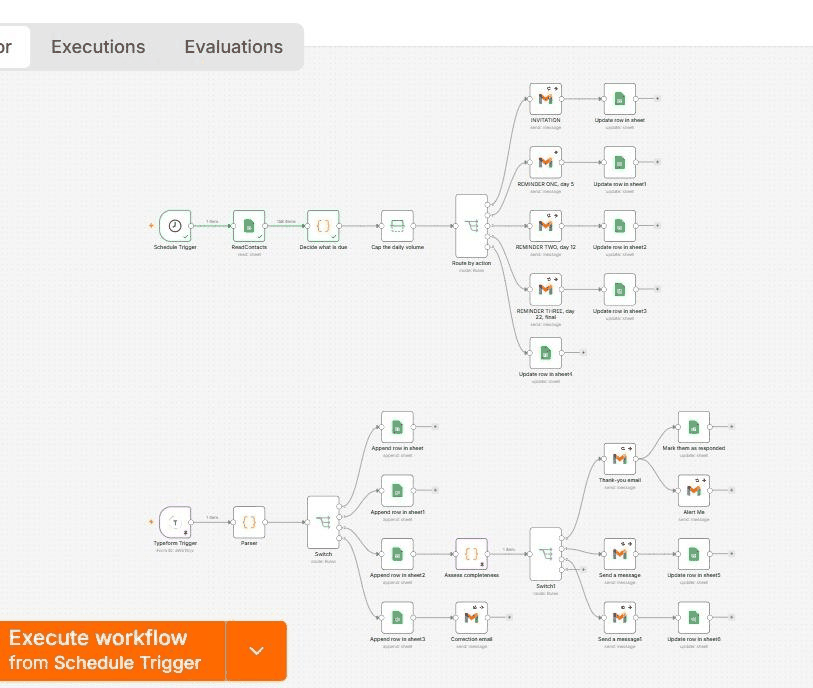
Built for the impact investment study. It sends each organisation its invitation and reminders at day 5, day 12 and day 22, writes every status back to the contact sheet, reads each reply as it arrives, rates how complete it is, and sends either a thank-you or a request for what is missing.

n8n workflow with a scheduled invitation and reminder branch and a reply processing branch
The workflow in n8n. The upper branch runs the invitation and reminder schedule; the lower branch processes each reply.

Opportunity Radar

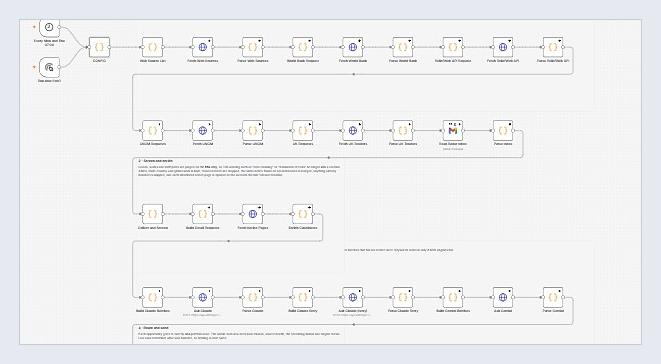
Replaces hours of checking donor and government tender websites by hand. I catalogued 184 sources across 111 websites by how each can be accessed, and ranked them by how many real opportunities they had produced. The radar monitors 70 or more of them on a schedule, removes duplicates, filters and scores what it finds, and sends a weekly summary to four team leads.

Two AI models and a rules-based scorer run side by side, and their results are compared before anything is sent, so no single model decides what reaches a colleague.

The Opportunity Radar workflow in n8n, four rows of connected nodes
The radar's workflow in n8n, from fetching the sources to scoring and sending.

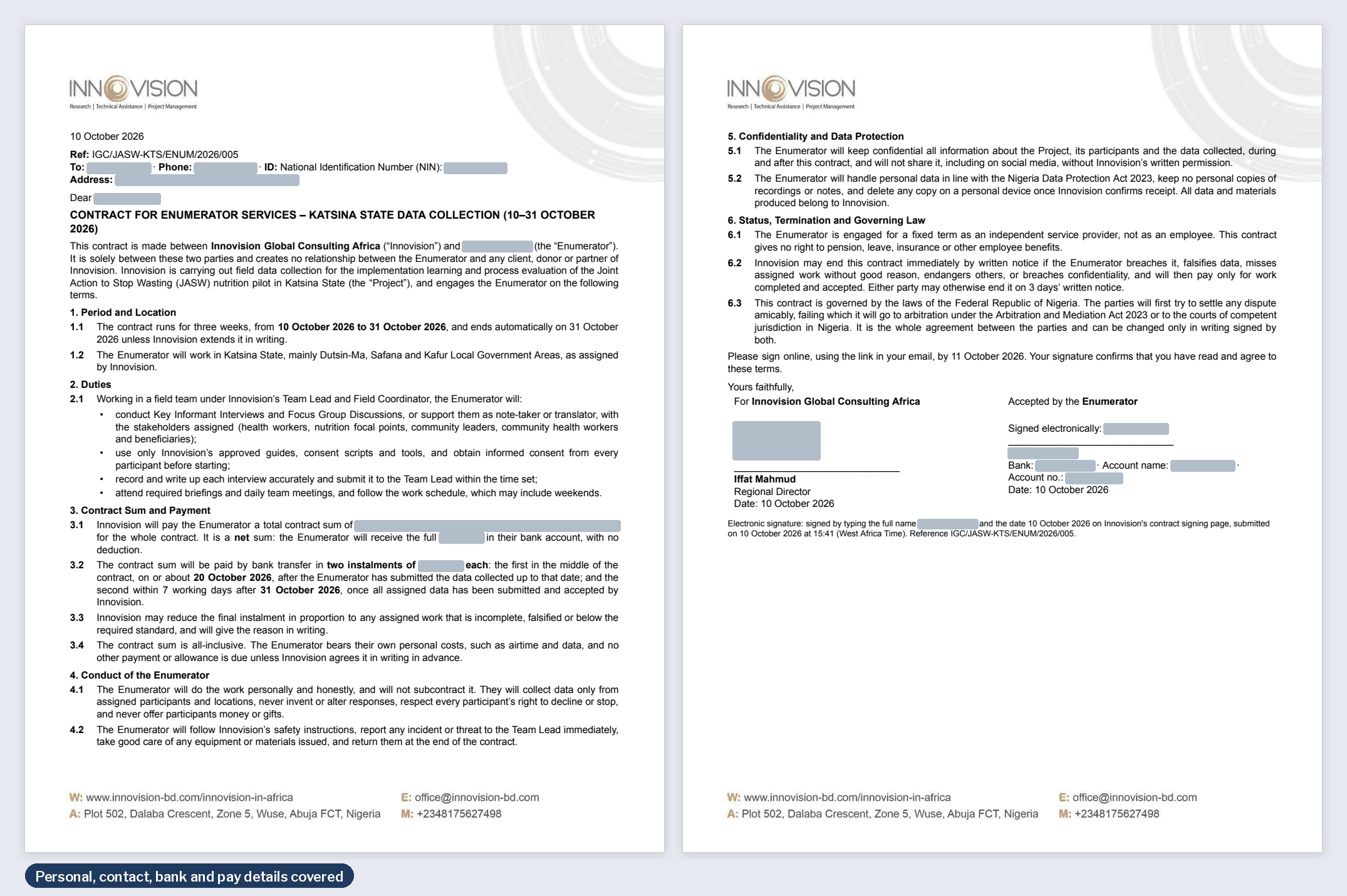
Field team contracting

Built for the Katsina field team. Team members submit their details on a form and sign their contract online, and signed copies and the payment list go to management and Accounts automatically.

A two-page enumerator contract produced by the system, with personal, contact, bank and pay details covered
A contract the system produced and a team member signed online. The signature is logged with its date and time.

Reading documents at scale

Python systems that read several hundred annual reports and financial documents and turn them into clean datasets, including matching and merging around 983 records from 35 separate spreadsheets.

Research and analysis

Selected studies, each shown with an output from the work itself.

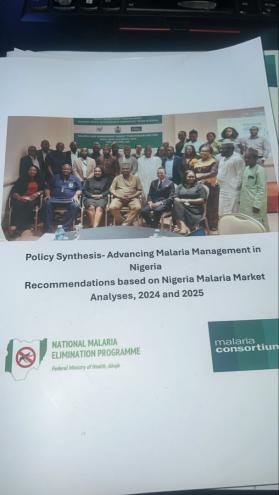
Policy synthesis from the Nigeria malaria market analyses
Policy synthesis from the 2024 and 2025 malaria market analyses, presented to NMEP and Malaria Consortium stakeholders.

Nationwide malaria market survey

Malaria Consortium and the National Malaria Elimination Programme, 2018 to 2025 series

Led the analysis of a national survey of 6,000 households and retail outlets across all six geopolitical zones, and co-authored the policy report whose pricing recommendations NMEP took up. Merged 15 or more survey rounds covering 1,800 people from 2018 to 2024 into a single dataset for the trend analysis.

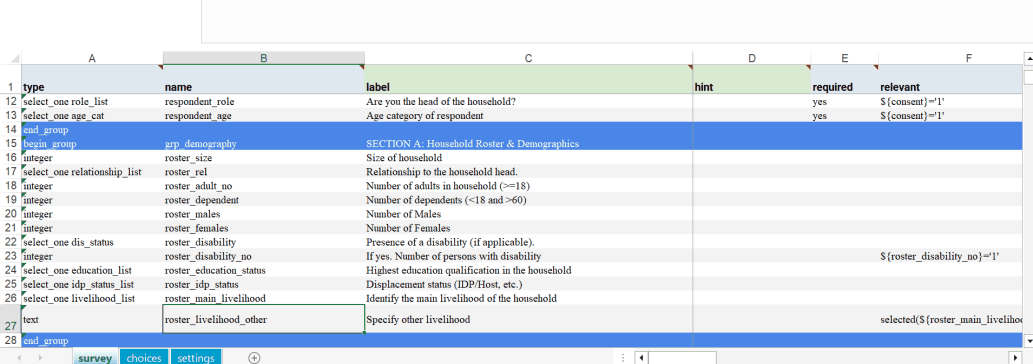
ODK survey definition for the Sokoto baseline
The survey form as written, with relevance and constraint rules at question level.

Green jobs and climate-smart farming baseline, Sokoto

Danish Refugee Council, European Union funded, 2025

Built the survey forms and ran the full analysis for 442 households across four local government areas, with every result broken down by displacement status, gender of household head, disability and income. Farmers using climate-smart practices produced roughly double the yield per hectare of those who did not, 883 kg against 433 kg, which became the report's headline finding.

Published brief from the Nigeria evidence series
A published brief from the series.

Public finance and the cost of living

Nigeria evidence series, 2022 to 2026 data

Tests whether Nigeria's recent surge in government revenue reached households, using only official published data. I wrote the third report in the series and built the analysis so that every figure is recalculated from the original government files each time it runs, checked against independently published numbers and logged with its source.

How I work

The FRAME Method is the model I designed for taking on any assignment, from framing the question to handing over work that runs without me.

FFrame the question

Agree the real question and what evidence would answer it, before committing to a method.

RRules and design

Fix definitions, classification rules and design decisions before the work starts.

AAcquire the evidence

Build and gather it hands on: instruments, fieldwork, primary sources.

MMeasure and verify

Analyse, then check each result against its source and flag confidence explicitly.

EEmbed for use

Document and automate so the work runs again without me, and translate it for whoever must act.

  • Every number traced. Each figure carries its source and a confidence grade, and a figure that fails its check stops the analysis instead of reaching a chart.
  • Corrected in the open. On a published report I worked through a 22-point outside review, checked every point against the source, and reported a finding as no longer holding when a stricter test showed it did not survive.
  • Ethics built in. Consent and confidentiality in every study, field teams trained on consent and child protection, and national ethics approval and PEPFAR data quality standards on health studies.

Background

Education

  • MSc Bioinformatics, DistinctionCovenant University, World Bank affiliated CApIC Centre of Excellence, 2025
  • BMLS Chemical PathologyAmbrose Alli University, Ekpoma, 2019
  • Data Analytics and Business IntelligenceDataleum, Lagos, 2022

Earlier roles

  • Graduate Research Assistant, World Bank CApIC-ACE projectCovenant University, 2023 to 2025
  • Survey Enumerator and Field Laboratorian, Nigeria ART Impact SurveyNASCP, NCDC and PEPFAR, 2024
  • Data Training and Development Coordinator, and Data AnalystAlphaTrack Intelligence, 2022 to 2025
  • Independent Field Monitor, national vaccination campaignWorld Health Organization, Ogun State, 2022
  • National service: elected President of the Medical Community Development Service group, leading three community health outreaches

Publications

  • Deciphering the genomic architecture of three major cancers in African-ancestry populationsDavid, E., Anthony, M. I., et al. (2025). doi:10.64898/2025.12.19.25342629
  • Bayesian meta-analysis of SRD5A2 polymorphisms and prostate cancer risk in African populationsIsewon, I., Anthony, M., et al. (2025). NIPES Journal of Science and Technology Research, 7(1). doi:10.37933/nipes/7.4.2025.si278
  • Adapting MobileSAM for few-shot segmentation of prostate cancer in histopathology imagesAnthony, M. I. (2025). MSc dissertation, Covenant University.
  • Systematic review of the prevalence of teenage pregnancy in NigeriaLead author. Completed, in preparation for submission.

Tools

Python (pandas, NumPy, statsmodels, matplotlib), SPSS, GraphPad and advanced Excel for analysis. ATLAS.ti for qualitative coding. ODK, SurveyCTO, KoboCollect, Typeform and CAPI for data collection. n8n and Google Apps Script, with Anthropic and Google model APIs, for automation. Power BI for dashboards. Linux and Bash.

Get in touch

Open to monitoring, evaluation and research roles, consulting assignments and commissioned studies. If you want to test any claim on this page, ask me for the source.

Anthony Micheal Idedia, Lagos, Nigeria. Updated October 2026. One HTML file, no tracking and no cookies. No respondent data appears on this page.